
It’s no exaggeration to say that the development of cryptocurrencies has influenced not only the financial sector but also the online gaming industry. In this context, one of the most important solutions emerging in crypto casinos is provably fair technology.
The goal here is to enable players to independently verify game results without having to rely solely on the operator’s assurances.
- How exactly does the provably fair mechanism work?
- Why is outcome verification so important for players?
- How does blockchain support transparency in cryptocurrency games?
Using cryptography, you can verify for yourself whether the outcome of a given game was randomly generated and wasn’t modified after the bet was placed. Read on to learn more!
How exactly does the provably fair mechanism work?
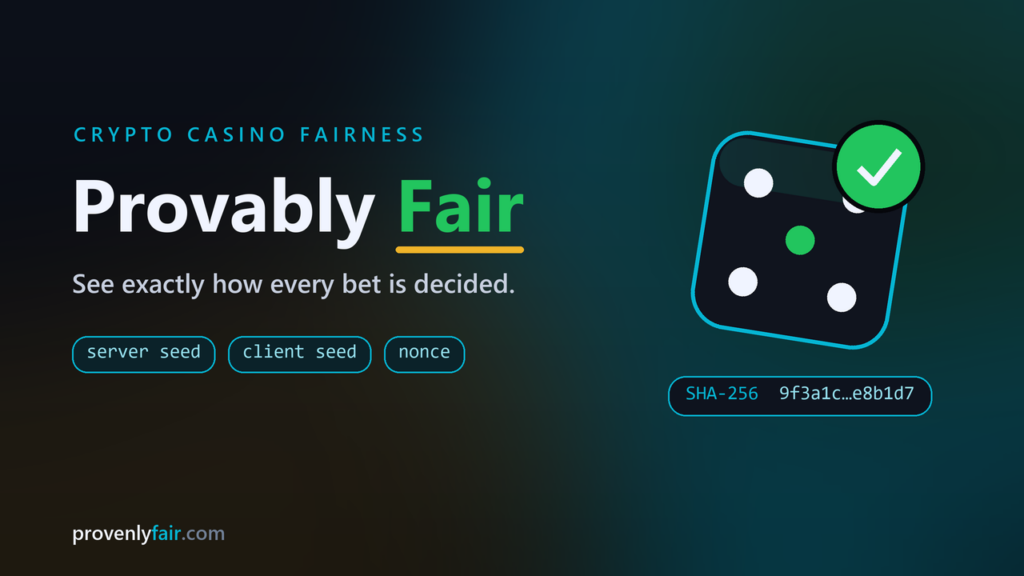
First things first: the foundation of a provably fair system is three elements: server seed, client seed, and nonce. The server seed is a random value generated by the game operator, while the client seed can be generated by the player or the system. The nonce is a counter that changes with each subsequent game.
Let’s take this understanding a step further: before starting a game, the casino provides an encrypted version of the server seed in the form of a cryptographic hash. After the session ends, you, as the player, receive the original value and can verify whether it matches the previously published hash. If the values match – that’s great, because it means the operator hasn’t changed the data after generating the result.
It’s worth expanding your knowledge on this topic through online resources like ProvenlyFair, which not only analyzes provably fair mechanisms but also presents information about crypto-casinos using such solutions.
Why is outcome verification so important for players?
In traditional online gaming, users typically rely on certificates and audits conducted by external companies. But Provably Fair technology has changed this, allowing for individual verification of each result. This means you can track the result generation process yourself and ensure no manipulation has occurred.
This is absolutely crucial in the cryptocurrency environment – where transparency and independent verification are core values.
How does blockchain support transparency in cryptocurrency games?
Finally, an interesting fact: some projects go a step further and use data stored directly on the blockchain. In such cases, the source of randomness may be information from public blocks or transactions, which are available to every participant in the network.
What does this approach offer? It also increases the transparency of the process, as the data stored on the blockchain is immutable and publicly available. Users can verify not only the algorithm for generating the result, but also the source of the data used to calculate it. This added value is worth knowing and taking advantage of when the opportunity arises.