
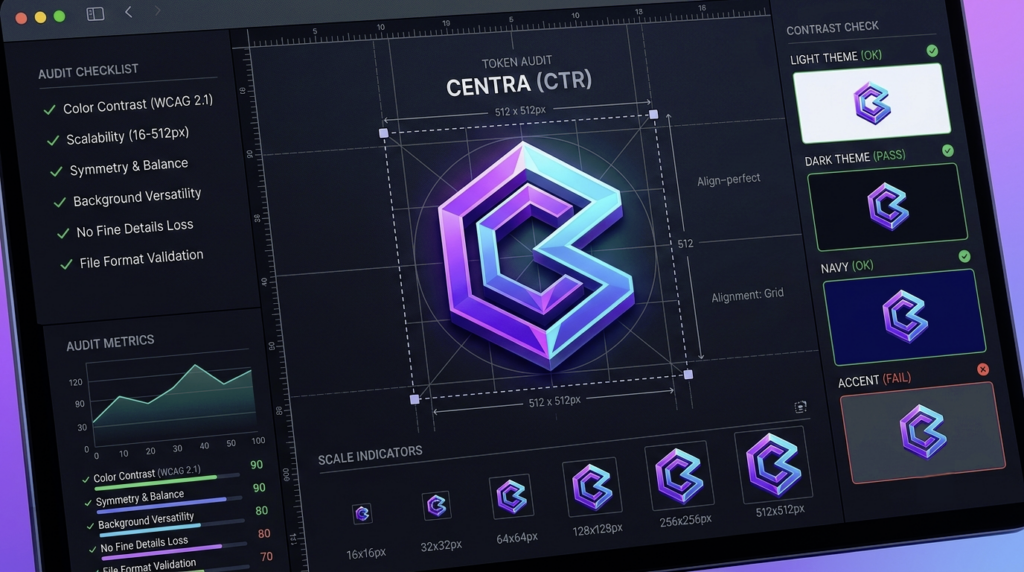
Passing exchange listing audits and decentralized exchange (DEX) metadata verifications requires more than just submitting a stylish graphic. As many as 1 million new crypto assets launch every week, and Web3 screeners enforce strict visual asset standardizations to keep token lists usable across mobile wallets, block explorers, and trading interfaces.
If your token icon degrades into an unreadable blur at micro resolutions or fails contrast checks on dark mode interfaces, listing managers will flag your project for poor technical presentation. Crafting a compliant token logo requires a systematic workflow that accounts for extreme scaling, multi-theme contrast, visual uniqueness, and precise asset delivery specs.
Designing for Micro Scales and Theme Adaptability
A token logo spends most of its lifecycle rendered at tiny dimensions. Wallet transaction feeds, token lists, and swap routes present icons as small as 16×16 or 24×24 pixels.
Complex illustrations, fine line work, and multi-word text marks fail instantly at this size. Focus on a single geometry or a bold monogram that retains its core outline when shrunk down to a fraction of an inch.
Theme adaptability is another frequent failure point during token due diligence. Decentralized applications (dApps) run on diverse UI color schemes, ranging from deep charcoal dark modes to bright white daylight themes. If your token relies on a pure black or pure white background, it will blend into the canvas on half of the platforms that list it.
Engineers at major platforms like Kraken require SVG vectors and standardized raster outputs to ensure token icons maintain visual fidelity across responsive web dashboards and native mobile applications. To keep your icon legible across all client interfaces, ensure your base asset complies with standard visual criteria:
- Safe padding of at least ten percent around the main symbol to prevent circular cropping from slicing off edges
- Solid contrast ratios that pass light and dark background visual audits without relying on drop shadows
- Distinct visual silhouette that remains recognizable even when rendered in pure grayscale mode
Testing these visual parameters early in the graphic design cycle saves your core team hundreds of hours during token minting and metadata registration.
Rapid Ideation and Visual Differentiation Analysis
Before locking down your final vector files, you must conduct a thorough market differentiation analysis. Thousands of tokens share similar naming conventions, ticker symbols, and visual metaphors. If your logo looks too similar to an established market cap giant, automated screening tools used by token registries may flag it as a potential phishing risk or copyright clone.
Start by surveying the top tokens in your immediate sector, whether that is decentralized finance, gaming infrastructure, or real-world asset tokenization. Map out their primary color palettes and geometric structures. If the top three protocols in your niche rely on blue isometric cubes, your design needs to deliberately branch out into different geometries or accent palettes.
During early conceptual phases, teams need to generate multiple distinct concepts rapidly to evaluate how different shapes perform in wallet UI previews. You can create brand logos instantly using Canva to test multiple structural directions before handing off the chosen concept to a vector artist for final node optimization. When speed is of the essence, and quality is also key, it’s a useful tool.
Once you have three to five viable concepts, place them directly into mock layouts of popular Web3 wallets. Inspecting your designs inside actual app UI containers immediately exposes structural flaws that look fine on a large design canvas.
Exporting Production Files for Token Registries
Once your visual identity passes internal review, you must prepare the final asset package for open-source token repositories and central exchange submission portals. Most token standards, including the widely used EVM token metadata guidelines on Ethereum, mandate specific file formats and canvas dimensions to ensure light file sizes and sharp rendering.
Never ship a logo with a baked-in square background unless that shape is an integral part of the brand element. Token lists almost universally require a transparent background so their UI can apply custom border radii or circular masks automatically.
Always export a clean vector master file in SVG format with all text paths converted to outlines. Alongside the primary SVG, generate square PNG files at standard resolutions like 512×512 and 200×200 pixels. Keep file sizes optimized under 100 kilobytes so dApp frontends can pull your icon instantly without clogging mobile network requests.
Final Checks
Completing all relevant technical checks before launching your liquidity pool ensures your token metadata updates smoothly on block explorers, portfolio trackers, and trading portals without getting stuck in due diligence queues. For more guidance and advice on a range of crypto topics, check out our other posts.