

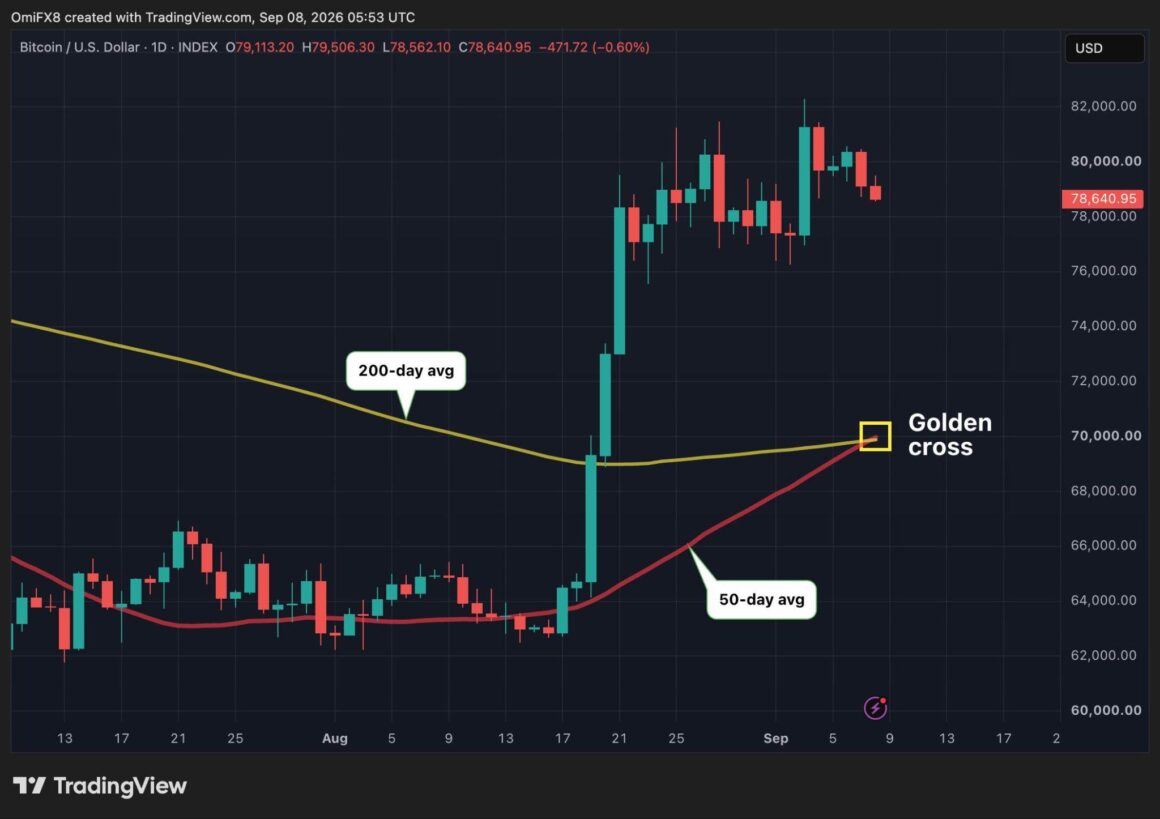
Bitcoin’s September rally was beginning to look convincing. After trading around the high-$76,000 to $77,000 area, BTC pushed above $80,000 and eventually reached $82,164, its highest level in more than three months. The move was fast enough to change the market conversation from recovery to potential breakout.
Then the momentum faded. By September 8–9, Bitcoin had moved back toward the $78,000 area, representing roughly a 5% retreat from the recent high. On its own, a 5% pullback is not particularly unusual for Bitcoin.
The more important question is why it happened. This decline is taking place while several macro variables are moving at the same time:
- Federal Reserve expectations are changing.
- U.S. inflation data is approaching.
- Brent crude is moving toward $100 per barrel.
- Treasury yields remain elevated.
- Geopolitical tensions are adding pressure to energy markets.
- Risk-sensitive assets are being reassessed.
That makes Bitcoin September 2026 less about measuring the size of the decline and more about understanding the environment surrounding it.
A simple 5% pullback after a strong rally can be ordinary profit-taking. A 5% pullback accompanied by changing interest-rate expectations, rising oil prices and an important inflation report ahead deserves closer examination.
Bitcoin’s $82K Rally Was Already A Macro Trade
The move toward $82,164 did not happen in isolation.
The September 3–4 Rally
Bitcoin had been trading around the high-$76,000 to $77,000 area before momentum accelerated.
On September 3, BTC briefly reached approximately $81,400. One factor supporting the move was Federal Reserve Governor Christopher Waller’s comments suggesting that he could support holding rates if inflation continued improving.
Bitcoin subsequently reached $82,164.
That sequence matters because it shows how quickly BTC responded to changes in expectations surrounding monetary policy.
|
Market Development |
Bitcoin Reaction |
|
BTC trading around $76K–$77K |
Recovery still developing |
|
More supportive Fed expectations |
Momentum accelerated |
|
BTC moves above $80K |
Breakout narrative strengthens |
|
BTC reaches $82,164 |
Three-month high |
|
Macro expectations change |
Previous gains begin to unwind |
|
BTC moves toward $78K |
Market reassesses the rally |
The same macro sensitivity that helped Bitcoin move above $82K is now helping explain why it has given back part of that advance.
That is an important distinction.
The September decline should not automatically be treated as a completely separate event from the rally. The two moves are connected through changing expectations about interest rates, inflation and broader risk appetite.
Why This Pullback Is More Complicated Than Profit-Taking
A normal correction can happen for a simple reason: traders take profits after a sharp rally.
That explanation is still possible.
But the current environment contains several additional variables.
1. Federal Reserve Expectations Are Moving
Markets have been reassessing the possibility of a September rate hike following stronger employment data.
Reuters reported that traders were pricing roughly a 60% probability of a hike, with other market readings briefly placing the probability even higher before it moderated.
This creates a very different environment from one in which investors are confidently expecting easier monetary policy.
For Bitcoin, the question is not simply whether rates are high or low.
It is whether expectations are becoming more restrictive or less restrictive than previously priced in.
2. Inflation Has Become A Near-Term Catalyst
The August U.S. Consumer Price Index is scheduled for September 11.
Economists were expecting:
|
Inflation Measure |
Expected Reading |
|
Headline CPI |
3.4% YoY |
|
Core CPI |
2.4% YoY |
A hotter-than-expected report could strengthen the argument that inflation remains persistent.
That could reinforce higher-for-longer expectations and create additional pressure on risk assets.
A softer reading could have the opposite effect by reducing some of the pressure surrounding monetary policy.
3. Oil Is Approaching $100
Brent crude was moving close to $100 per barrel on September 9.
The increase is linked to escalating Middle East tensions and concerns surrounding energy infrastructure and supply.
Oil matters to Bitcoin because it can influence the inflation outlook.
The relationship is not mechanical, but sustained energy-price increases can make investors more cautious about the possibility of persistent inflation.
4. Geopolitical Risk Is Entering The Macro Equation
Geopolitical developments are no longer simply background headlines for financial markets.
When geopolitical tensions affect energy infrastructure or oil supply, they can feed directly into:
Oil → Inflation expectations → Fed expectations → Treasury yields → Risk appetite
Bitcoin sits inside that broader chain as a risk-sensitive asset.
5. Treasury Yields Remain Important
Higher Treasury yields can make yield-bearing assets relatively more attractive compared with assets that do not provide a traditional yield.
That can contribute to a broader risk-off environment.
Therefore, the September Bitcoin decline is not necessarily a crypto casino specific selling event.
It may be partly reflecting a wider repricing of risk.
$80K Matters, But Calling It “Strong Support” Misses The Point
Round numbers naturally attract attention.
For Bitcoin, $80,000 is particularly significant because BTC recently crossed it during the rally and then moved back toward it during the pullback.
But that does not automatically make $80K a guaranteed technical support level.
Its importance is more psychological.
Why Traders Are Watching $80K
- It is a major round-number threshold.
- Bitcoin recently broke above it.
- Traders can compare current price action against the recent breakout.
- Holding above it can reinforce the recovery narrative.
- Repeated failure around it can weaken that narrative.
The better question is therefore not:
“Will $80K hold?”
It is:
“What does Bitcoin’s behavior around $80K tell us about demand?”
That produces several possible outcomes.
|
BTC Behavior Around $80K |
Possible Interpretation |
|
Brief dip below $80K followed by a quick recovery |
Normal consolidation may still be possible |
|
Multiple failed attempts to reclaim $80K |
Sellers may be gaining control |
|
Reclaim of $80K after CPI uncertainty |
Macro pressure may be getting absorbed |
|
Sustained move below $80K alongside weaker risk assets |
Broader risk-off repricing becomes more plausible |
This makes $80K useful as a reference point without pretending that one price level can predict the entire market.
The $82K To $78K Move Provides The Real Study Case
The recent price sequence tells a more useful story than simply saying Bitcoin fell 5%.
September Price Sequence
September 2
BTC traded around $77.3K
↓
September 3
BTC rallied toward $82.16K
↓
September 4
BTC pulled back toward approximately $79.7K
↓
September 7
BTC closed around $79.1K
↓
September 8
BTC reached an intraday low around $77.7K, with an approximately $78.5K close in Investing.com’s data.
The sequence shows three important things:
The sharpest interpretation is not that Bitcoin suddenly became bearish.
It is this:
The market has moved from asking how high Bitcoin can go to asking how much macro risk Bitcoin can absorb.
That is a more useful way to understand Bitcoin September 2026.
What Would Invalidate The Bearish Interpretation?
A balanced analysis needs to consider what could prove the current weakness less significant.
The pullback does not become a larger bearish structure simply because BTC falls from $82K to $78K.
Several developments could weaken the bearish interpretation.
Bitcoin Reclaims $80K
A fast recovery above $80K would suggest that sellers were unable to turn the pullback into a sustained breakdown.
BTC Challenges $82K Again
If Bitcoin returns toward the recent high, the argument that the breakout has failed becomes much weaker.
A new test of $82K would also show that buyers remain willing to absorb macro uncertainty.
Inflation Comes In Cooler
A softer CPI reading could reduce pressure surrounding the Federal Reserve.
That could reverse part of the recent rate-hike repricing.
Fed Expectations Become Less Hawkish
If markets shift away from expectations of a September hike and back toward a hold, Bitcoin could regain some of the macro support that helped fuel the original rally.
Oil Prices Retreat
A meaningful decline in crude prices could remove some immediate inflation pressure.
Risk Assets Recover Together
If stocks, crypto and other risk-sensitive assets regain momentum at the same time, the Bitcoin decline would look more like consolidation than a structural change in risk appetite.
What Would Make The Bearish Case Stronger?
Rather than predicting a specific downside target, investors can look for confirmation.
A more convincing bearish setup would involve several signals appearing together.
Stronger Bearish Evidence
- Bitcoin repeatedly fails to reclaim $80K.
- The $82K breakout becomes a clear failed breakout.
- Inflation exceeds expectations.
- Rate-hike expectations increase further.
- Oil remains around or above $100.
- Treasury yields continue moving higher.
- Other risk assets weaken simultaneously.
- BTC begins forming lower highs and lower lows.
The distinction is important.
One failed test of $80K is not enough to establish a bearish market structure.
A sequence of failed recoveries combined with worsening macro conditions would be much more significant.
Bitcoin Correction Or Something Bigger?
There are three reasonable scenarios for the current setup.
Scenario A: Normal Correction
The first possibility is straightforward.
- Bitcoin rallies from approximately $77K to $82K.
- Traders lock in profits.
- BTC consolidates around $78K–$80K.
- Inflation remains manageable.
- Fed expectations become less restrictive.
- Bitcoin eventually recovers $80K.
Interpretation: The September decline is primarily a healthy consolidation following a sharp rally.
Scenario B: Macro-Driven Repricing
The second scenario is more concerning.
- Inflation remains sticky.
- Oil stays elevated.
- Fed expectations become more hawkish.
- Treasury yields continue rising.
- Risk assets weaken.
- Bitcoin cannot reclaim $80K.
Interpretation: The pullback becomes part of a wider change in risk appetite rather than a simple profit-taking event.
Scenario C: False Bearish Signal
The third possibility is that the market is temporarily overreacting.
- BTC falls below $80K.
- CPI comes in softer than expected.
- Fed expectations reverse.
- Bitcoin quickly recovers $80K.
- BTC challenges the $82K area again.
Interpretation: Much of the September weakness was positioning and short-term profit-taking rather than a structural deterioration.
|
Scenario |
Key Conditions |
Market Interpretation |
|
Normal Correction |
BTC stabilizes and retakes $80K |
Profit-taking/consolidation |
|
Macro Repricing |
Inflation, oil and yields remain elevated |
Broader risk-off environment |
|
False Bearish Signal |
Softer CPI and quick BTC recovery |
Temporary positioning pressure |
Where The Bitcoin Correction Fits Into The Bigger Picture
The useful question is not whether a Bitcoin correction is happening. It clearly is.
The more important question is whether the correction changes the underlying market structure.
For traders and investors following the move, the focus should remain on the interaction between price and macro conditions.
For a deeper look at the latest Bitcoin correction, the move is best evaluated alongside the changing inflation, oil and Federal Reserve backdrop rather than through price charts alone.
This makes the correction more than a technical event.
It becomes a test of whether Bitcoin can maintain demand while the macro environment becomes less supportive.
What To Watch Between September 9 And The Fed Meeting
The next several sessions are unusually important because multiple catalysts are approaching at the same time.
September 11: CPI
The inflation report provides the first major test.
A hotter reading could increase rate-hike expectations.
A softer reading could reduce them.
September 15–16: Federal Reserve Meeting
The Fed decision will provide another major signal for markets.
What matters is not only the decision itself but also how policymakers communicate their assessment of inflation and future rates.
Oil Prices
Brent approaching $100 gives energy prices another role in the inflation debate.
A continued rise would keep inflation concerns elevated.
A reversal could reduce some of that pressure.
Bitcoin Around $80K
BTC’s behavior around $80K can help determine whether the recent decline is being absorbed.
The combination is more informative than any single indicator.
CPI + Fed expectations + oil + Treasury yields + BTC price structure
That is the framework worth watching.
Bitcoin September 2026: Market Snapshot
|
Metric |
September 9, 2026 Context |
|
Recent BTC High |
$82,164 |
|
Current BTC Area |
~$78K–$79K |
|
Pullback From Recent High |
~5% |
|
Key Psychological Level |
$80,000 |
|
CPI Release |
September 11 |
|
Federal Reserve Meeting |
September 15–16 |
|
Brent Crude |
Near $100/barrel |
|
Main Macro Pressures |
Inflation, oil, Fed expectations, geopolitics |
|
Central Question |
Consolidation or macro-driven repricing? |
BTC was around $78,680.60 on September 9 as Brent crude approached $100 and markets remained focused on upcoming inflation data and the Federal Reserve decision.
The data creates a useful snapshot, but it does not justify a definitive prediction.
Three Things Bitcoin Traders Should Focus On
Instead of trying to predict the next exact price, three questions are more useful.
1. Can Bitcoin Reclaim $80K?
A sustained recovery would suggest that demand remains strong enough to absorb the current macro pressure.
Repeated rejection would tell a different story.
2. What Does CPI Do To Rate Expectations?
The inflation number matters because it can change expectations for monetary policy.
A market that becomes less confident about a rate hike could quickly change the Bitcoin narrative.
3. Can BTC Hold Up While Macro Conditions Remain Difficult?
This may ultimately be the most useful test.
If Bitcoin recovers despite high oil prices, elevated yields and uncertain Fed expectations, that would demonstrate stronger underlying demand.
If BTC continues weakening as those pressures intensify, the bearish interpretation becomes more credible.
FAQs
Why Can Bitcoin Rise When Interest Rates Are Still High?
Bitcoin does not respond only to the current interest-rate level. Markets also price expectations for future monetary policy. If traders believe policy will become less restrictive than previously expected, BTC can rise even while rates remain relatively high.
Does A 5% Bitcoin Drop Mean The Bull Market Is Over?
No. A 5% move by itself cannot establish a long-term trend reversal. Bitcoin regularly experiences substantial short-term price movements. The more important evidence would be a sustained series of lower highs and lower lows combined with weakening demand and broader risk-off conditions.
Why Does Brent Crude Matter To Bitcoin Investors?
Oil can influence inflation expectations. If sustained energy-price increases create additional inflation pressure, markets may expect monetary policy to remain restrictive for longer. That can affect risk appetite across financial markets, including Bitcoin.
The Bigger Lesson From Bitcoin September 2026
The most important takeaway from Bitcoin September 2026 is not that BTC moved from $82K to $78K.
It is how that move happened.
Bitcoin’s rally toward $82,164 was partly driven by changing expectations around monetary policy. When those expectations shifted, some of the rally was reversed.
At the same time, the market is dealing with:
- Upcoming inflation data
- Potential changes in Fed policy expectations
- Brent crude approaching $100
- Elevated Treasury yields
- Geopolitical uncertainty
- Broader risk-asset repricing
That makes the current pullback more interesting than an ordinary summer-style dip.
A 5% decline after a rapid rally can be completely normal. But when that decline occurs while several macro variables are changing simultaneously, the market needs to determine whether Bitcoin is simply digesting gains or repricing a new level of risk.
The most useful thesis is therefore simple:
The character of the pullback matters more than the size of the pullback.
If BTC quickly reclaims $80K and eventually challenges $82K again, the September weakness may prove to be little more than consolidation.
If Bitcoin repeatedly fails to recover while inflation, oil prices, yields and Fed expectations become more restrictive, the correction could become part of a broader shift in risk appetite.
For now, the market has not conclusively answered that question.
And that uncertainty is exactly what makes Bitcoin September 2026 worth watching.