
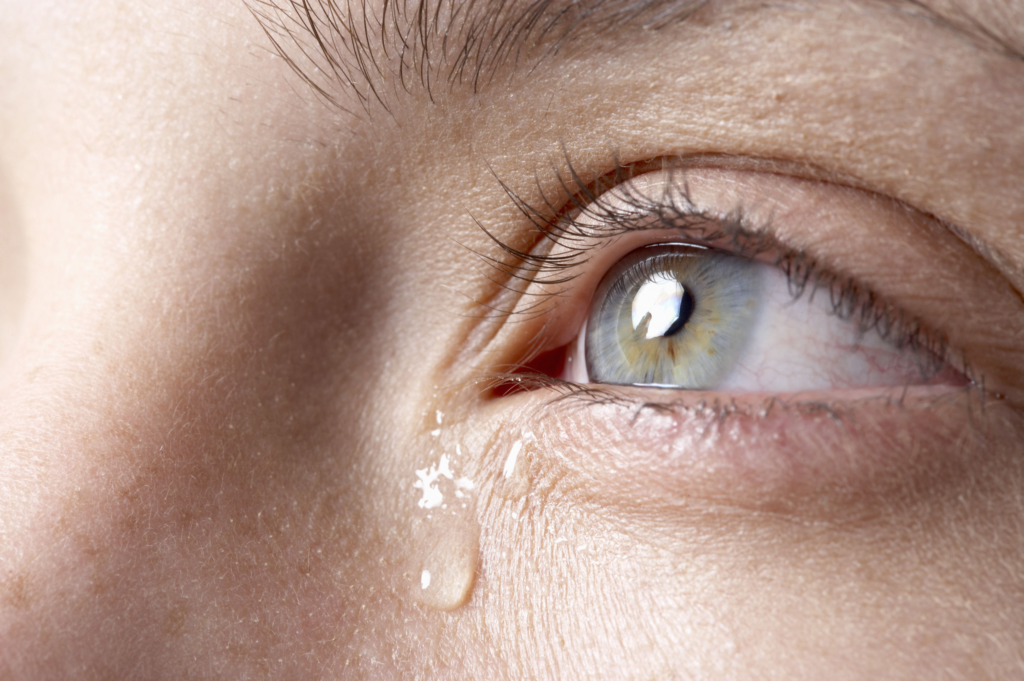
Most of us know the feeling. A long, hard cry leaves you wrung out but somehow lighter, like a pressure valve has finally been opened. That sense of relief isn’t only in your head. The tears that run down your face during a rough moment are chemically different from the ones you shed over a cutting board, and that small fact opens a surprisingly deep window into how your body handles emotion.
Three Tears, Three Recipes
Your eyes don’t make one all-purpose tear. They make three, and each shows up with its own ingredients and its own reason for being there.
The Everyday Tears
Basal tears are the ones you never notice. They coat your eyes around the clock with a thin film of water, oil, salt, and an enzyme called lysozyme that helps fight off bacteria. Without them, you couldn’t blink comfortably or see clearly for long.
The Onion Tears
Reflex tears are your eyes’ emergency crew. When smoke, dust, or onion fumes show up, your eyes flood with watery tears, roughly 98 percent water, to rinse the irritant away as fast as possible. There’s nothing emotional about them. They’re pure cleanup.
The Feeling Tears
Then come the tears that make us human. Emotional tears arrive with grief, joy, frustration, and everything in between, and they carry cargo the other two don’t. When biochemist William Frey studied them in 1981, he found they held more protein and a cluster of stress-related chemicals:
- Prolactin, a hormone that climbs when we’re under emotional strain.
- ACTH, a clear sign the body is busy handling stress.
- Leucine-enkephalin, a natural painkiller that nudges your mood upward.
Because they’re richer in protein, emotional tears are a little thicker, which is part of why they seem to linger on your cheeks instead of quickly rinsing away. That same protein load is also why a good cry can feel physically draining, almost as if your body had been doing real work, because in a small chemical sense, it had.
Why We Chase a Shift in Mood
Tears are one way the body resets after a wave of feeling, but they’re far from the only way we go looking for a change in mood. When emotions run high, or a day feels flat, plenty of people reach for a quick bit of fun to even themselves out, and these days that often lives on a phone.
Mobile gaming slots right into that habit. Someone who enjoys a few spins on a coffee break can grab the verde casino apk to set up the operator’s Android app, which brings the welcome package, ongoing promotions, and a full library of slots and table games onto the home screen. With secure deposits, quick withdrawals, and live dealer rooms folded into a single download, the small thrill of a spin sits just a tap away, which becomes its own form of emotional release for fans of casino entertainment.
The Catch Nobody Mentions
It’s tempting to push this further and assume each emotion brews its own special tear, that sadness, joy, and anger each leave a unique chemical mark. It’s a wonderful story. It just isn’t proven.
Direct studies comparing tears from different emotions are rare, and the most researchers can say with real confidence is that emotional tears differ from reflex ones, not that happy tears differ from sad ones. You may have seen striking microscope photos labeled “tears of joy” or “tears of grief,” each looking like its own delicate snowflake. Those images are art, not evidence. The shapes come from how each drop happened to dry on the glass slide, not from the feeling that produced it. So while your tears clearly know the difference between an onion and a heartbreak, they almost certainly can’t tell happy from sad. The honest version of the headline is narrower but still fascinating: it’s the kind of trigger, emotional versus physical, that changes the recipe, not the exact shade of feeling behind it.
What Tears Are Really For
If emotional tears aren’t a secret mood-detecting code, what are they doing? One of the most convincing answers points outward, not inward.
A tear-streaked face is nearly impossible to ignore. It signals to the people around us that we’re hurting, overwhelmed, or deeply moved, and it draws them in, often before a single word is spoken. Seen that way, crying isn’t really about the chemistry at all. It may have taken shape as a survival tool for a deeply social species, a visible flare that says I need you without forcing us to explain ourselves.
So the next time your eyes well up, the remarkable part isn’t what’s dissolved in the drop. It’s that your body found a way to ask for connection that the people around you understand instantly, no translation required. Tears may be salt water with a little extra protein, but what they accomplish is something no lab result can fully measure: they make our inside world visible, and they invite someone else to step toward it.