
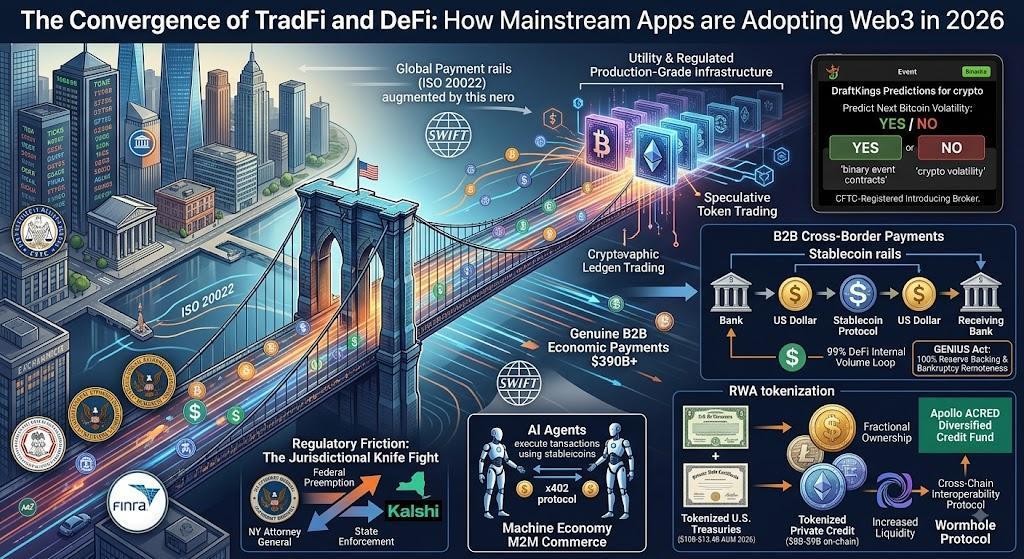
The tribal war between Wall Street and crypto idealists is officially dead. You walk into any major proprietary trading firm today in 2026, and the distinction between a decentralized liquidity pool and a traditional dark pool is virtually nonexistent. Capital has already colonized the blockchain. We finally abandoned speculative token trading in favor of production-grade financial market infrastructure. That was a brutal, necessary purge. It left behind only the networks capable of handling corporate treasury operations and mainstream consumer flow. Let's be real—the migration of trust from siloed institutional databases to shared cryptographic ledgers was never driven by ideology. Greed and operational efficiency simply forced the issue.
Gamifying the Greek Letters: When Retail Becomes the Clearinghouse
Consumer entertainment platforms realized traditional user acquisition models were bleeding them dry. Sports betting operators hit a wall with standard product expansion long ago. They needed a ruthless new mechanism to convert retail consumers into continuous, high-frequency liquidity providers. Web3 market mechanics provided the exact answer.
DraftKings completely bypassed state-level gaming gridlock by registering as an Introducing Broker under the oversight of the CFTC. The company did not just add a flashy new tab to their mobile app. They acquired Railbird Exchange to internalize massive flows of derivatives trading. Look closer and you will notice that retail participants are essentially trading binary event contracts; these are just disguised as pop-culture and macroeconomic propositions. Management weaponized DraftKings Predictions for crypto to aggressively capture digital asset volatility volume directly alongside Sunday football lines.
It worked. By mid-2026, this specific product cleared $11 billion in annualized volume. Prediction customers cost significantly less to acquire, yet they trade with the chaotic velocity of seasoned options traders. Institutional arbitrage desks are actually eating up 80% to 90% of this prediction volume in non-sportsbook jurisdictions. Retail brings raw liquidity. Quantitative shops like DRW, Jump Trading, and Susquehanna just sit back and sweep the massive bid-ask spreads.
The Jurisdictional Knife Fight
This rapid financialization of retail event contracts predictably triggered a brutal regulatory turf war. State gaming regulators are terrified of losing their cut. New York Attorney General Letitia James threw the first major punch in July 2026 by suing Kalshi. Her office desperately wants to label these contracts as illegal, unlicensed gambling. That lawsuit represents an existential threat to the sector, specifically targeting the nomenclature of "event contracts" to assert state jurisdiction.
The federal government is playing a completely different game. The CFTC dropped a massive 267-page Notice of Proposed Rulemaking just a month prior. Washington basically established a permissive pathway for macroeconomic and political contracts, preempting state gaming definitions entirely. Wall Street lawyers are treating this as a massive green light. They know federal supremacy usually wins these legal knife fights, providing the exact regulatory cover institutional capital requires to fully deploy into the prediction market sector.
The 1% Paradox and the Corporate Stablecoin Trojan Horse
A pivot away from the consumer layer reveals an enterprise reality that is even more ruthless. Corporate treasurers do not care about decentralization. They care about trapped liquidity and the exorbitant fees extracted by the SWIFT network. The global stablecoin supply sits comfortably north of $316 billion today. Those headline numbers are wildly misleading, though.
Analysts call it the 1% paradox. We saw roughly $33 trillion in on-chain stablecoin transfer volume last year, but automated DeFi arbitrage and liquidity pool rebalancing generated almost all of it. A mere $390 billion represented actual, real-world economic payments. Frankly, that sliver of genuine economic activity is the most disruptive metric in the entire financial sector. Multinational corporations are systematically abandoning correspondent banking routes—which suffer from multiple intermediary fees and multi-day settlement delays—to settle B2B cross-border transactions in seconds.
The passage of the GENIUS Act in July 2025 provided the bulletproof legal framework these compliance departments demanded. U.S. dollar reserves are now strictly audited by law. Bankruptcy remoteness is permanently guaranteed. The jurisdictional turf war between the SEC and CFTC over stablecoins is finally over. Stripe dropping $1.1 billion on Bridge was never a venture capital bet. It was a highly calculated infrastructure acquisition to solve the last-mile fiat off-ramp problem across forty countries. Legacy Treasury Management Systems like Kyriba now use API connectors to format blockchain settlements into standard ISO 20022 XML data. This completely hides the cryptographic plumbing from the CFO's dashboard.
Machines Do Not Have Bank Accounts
The catch? Human corporate treasurers are no longer the only entities requiring high-throughput payment rails. We have roughly 100,000 autonomous AI agents executing daily microtransactions right now. These bots need to secure compute power and access premium API feeds without human intervention. Traditional credit card networks enforce thirty-cent fee floors. That renders algorithmic machine-to-machine commerce financially impossible.
AI agents lack legal personhood. A neural network cannot pass a basic KYC check or open a checking account at Chase. Web3 infrastructure is the absolute default payment rail for the machine economy because it is the only system capable of handling fractional-cent settlements with near-zero latency. The revived HTTP 402 protocol allows servers to demand payment programmatically. These agents settle the demands instantly using stablecoins. This invisible economic layer is generating severe structural pressure on legacy networks; Visa and Mastercard simply cannot process millions of simultaneous sub-penny transactions.
Securitize Reality Without the Back-Office Bloat
Real-world asset tokenization finally escaped the purgatory of theoretical pilot programs. The on-chain value of tokenized assets just eclipsed $30 billion. U.S. Treasuries and private credit drove almost all of that institutional volume. Asset managers like BlackRock and Franklin Templeton weaponized the blockchain to distribute institutional money market yields directly into the DeFi ecosystem.
The real breakthrough occurred quietly in May 2026. FINRA granted broker-dealers the authority to natively custody tokenized securities. This single regulatory shift demolished the legacy Wall Street back office forever. Before this ruling, you needed a fragmented mess of specialized qualified custodians to hold digital assets. Today, platforms like Securitize operate as the issuer, transfer agent, broker-dealer, and custodian all at once.
Securitize merged with Cantor Equity Partners II for $1.25 billion precisely because they now own the entire vertical stack. Private credit heavyweights like Apollo and KKR are routing structured products on-chain right alongside them. Cross-chain interoperability protocols like Wormhole allow institutional capital to move seamlessly between Ethereum, Avalanche, and Base without sacrificing a drop of asset mobility.
Atomic Settlement Is an Offensive Strategy
Global Financial Market Infrastructure is undergoing a violent reconfiguration. The Bank for International Settlements is pushing the Unified Ledger concept to smash together tokenized commercial bank deposits, wholesale CBDCs, and tokenized assets into a single highly programmable environment. Bilateral reconciliation is a complete relic of the past.
Institutions are shifting risk management directly into the programmable logic of the infrastructure itself. Atomic settlement eliminates counterparty default risk mid-transaction by swapping assets and payments instantaneously. Wall Street banks are adopting hybrid governance models instead of fully open networks. They leverage the deep liquidity of public blockchains while strictly enforcing on-chain KYC whitelists. The convergence of TradFi and DeFi is not some utopian financial democratization. It is a calculated, aggressive upgrade by institutional heavyweights to monopolize the settlement layer of the internet. You either adapt your clearing systems to cryptographic ledgers today, or you become obsolete liquidity by the end of the decade.