
Stablecoins solved the hardest part first. You can hold digital money that doesn’t swing in value. You can send it across the world in seconds. You can receive payments without relying on a bank. So in theory, crypto is ready for everyday use. But then you try to pay for something – and you start second-guessing everything.
The Moment It Stops Being Smooth
Let’s say you get paid in USDT. The money arrives instantly. No delays, no friction. It feels efficient. Later that day, you try to use it. Maybe you’re paying for a subscription, ordering something online, or just grabbing dinner while traveling. That’s when things change.
You start thinking:
- Do I need to convert this first?
- Which app do I use?
- Will this even work here?
Nothing is broken. But nothing feels simple either. That’s the gap.
Crypto Is Fast – Until It Isn’t
Onchain, crypto is fast. That part is solved.
But real life doesn’t happen on-chain. It happens at checkout – on websites, in stores, at terminals that expect traditional payments.
And that’s where crypto loses its advantage. Not because it can’t work – but because it doesn’t connect directly to the way you already pay.
Where You Actually Lose Money
This is the part most people don’t notice at first.
You’re not just losing time – you’re often losing money in small, hidden ways:
- Withdrawing cash and paying ATM fees
- Accepting bad exchange rates without realizing it
- Paying in the wrong currency at checkout (DCC markups)
- Moving funds multiple times and paying fees each step
Individually, these don’t feel like much. But over time, they add up. And they all come from the same problem:
Your money isn’t ready to use when you need it.
What a Working Experience Actually Looks Like
Now flip the situation. You still get paid in stablecoins. But this time, you don’t think about what to do next.
You go to pay – and it just works. You tap your phone using Apple Pay or Google Pay. Or you use your card online. The amount shows up clearly, you confirm, and that’s it. No prep. No switching apps. No second-guessing.
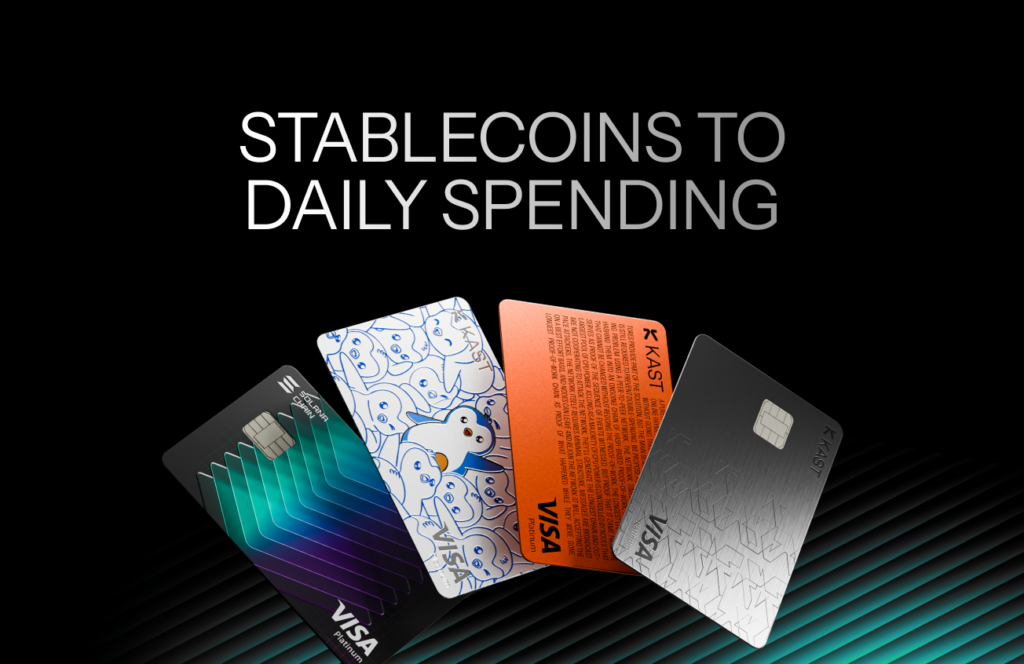
With something like a KAST card, your stablecoin balance is already connected to a payment method you can use instantly. The conversion into local currency happens in the background, so from your perspective, the experience stays consistent.
You don’t adapt to the system. The system adapts to you.
Where It Starts to Feel Different
The difference becomes obvious in everyday moments.
You land in another country and pay for a ride – no need to exchange cash. You subscribe to a service priced in another currency – no confusion about the final amount. You buy something online – no extra steps before checkout.
And over time, something else happens. Your spending starts working in your favor.
With the KAST card, everyday payments – food, transport, subscriptions – can earn USD cashback on every purchase. What used to be just spending starts generating small returns.
Use it regularly, and those small amounts build up. In practice, daily usage can add up to 3%, without changing how you spend.
When It Becomes Worth Sharing
The moment something works consistently, you stop thinking about it. And when that happens, you naturally start telling people. If a friend is dealing with the same friction – moving funds, converting, figuring out how to pay – you don’t explain the system. You just show them what works.
With KAST, that also comes with an upside. If they start using it too, referral rewards can be available per person, depending on the program terms. Not because you’re promoting something – but because the experience actually solved a problem you had.
The Real Shift Isn’t Technical
Crypto doesn’t need another breakthrough in speed or scalability.
It already works. What’s been missing is the connection between having money and being able to use it instantly, anywhere, without extra thought. That’s not a protocol problem. That’s an experience problem.
Closing the Gap
Stablecoins made digital money stable. What comes next is making it usable.
When your balance is already connected to how you pay, everything changes. You stop managing systems and start relying on your money to just work. If you want to understand that shift, the easiest way is to try it. Use it in real situations – pay, tap, move on. And if it fits naturally into your routine, sharing it with someone else becomes the obvious next step.
Because once that missing layer is in place, crypto doesn’t feel like something separate anymore.
It just becomes money. Learn more about the KAST card