

The financial landscape of 2026 has transformed into a high-tech “glass house” where every transaction on a centralized platform is indexed, analyzed, and reported. For high-net-worth individuals and “Whales,” this level of transparency is not a security feature; it is a direct threat to their capital and personal safety.
As regulatory frameworks like MiCA tighten their grip, the elite tier of traders is looking for a “disappearing act” from the surveillance loop. This has led to a massive surge in the use of non-custodial bridges for privacy coins like Swap USDT to XMR anonymously, allowing investors to move their liquid wealth into a protected environment where it can no longer be tracked or frozen by centralized gatekeepers.
The “Silo Tax” and Privacy Liquidity Fragmentation
By 2026, the rise of specialized chains and regional liquidity hubs has made this problem worse, particularly for privacy assets like Monero (XMR). Many centralized exchanges, under intense pressure from global regulators like MiCA and the SEC, have delisted privacy coins entirely. This has created a “Silo Tax”—where the few remaining exchanges with XMR liquidity have massive spreads, causing high-volume traders to lose significant value due to slippage.
Attempting a large-scale move into privacy assets on a single CEX is an invitation for predatory bots to front-run the trade. Aggregators solve this by dissolving the walls between providers. Instead of pushing a large block into one shallow pool, the smart routing logic identifies the best available rate across a vast network of liquidity providers, ensuring that the whale secures the most favorable entry price without alerting the broader market.
Why Choosing Smart Crypto Aggregators for Privacy Assets
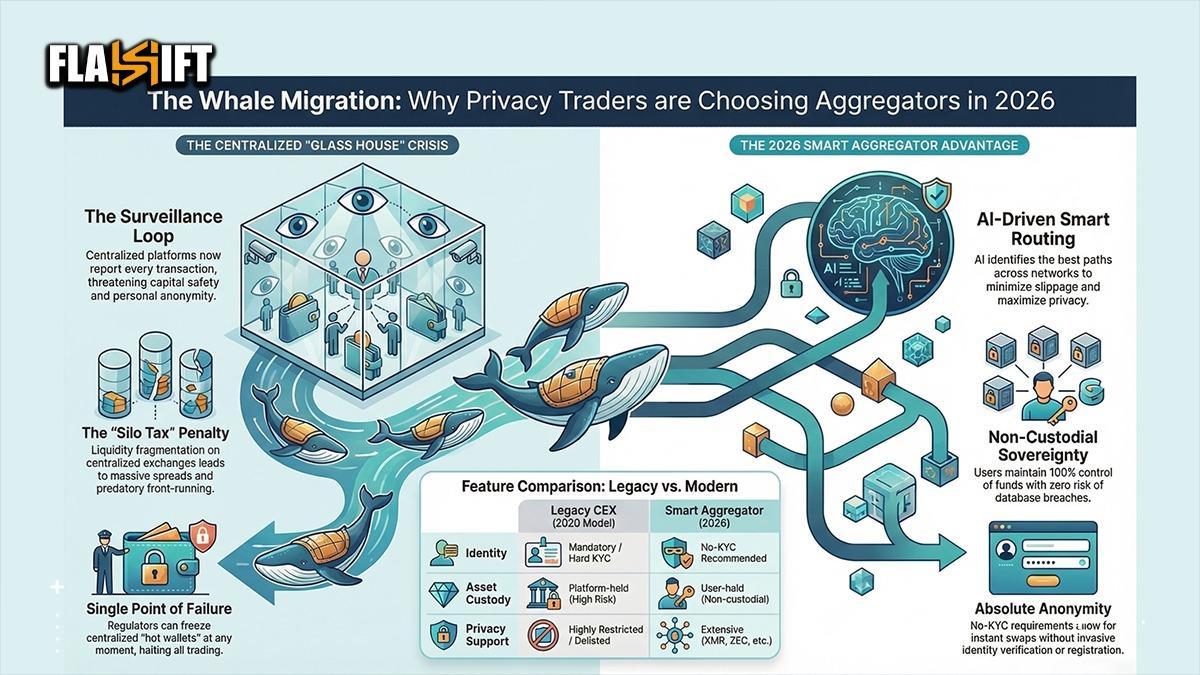
Aggregators has emerged as the essential gateway for the 2026 privacy-first market. Rather than operating as a slow, bureaucratic middleman, it functions as a high-speed efficiency layer for peer-to-peer asset exchange. But the question is which platform is smart enough to provide an all-in-one package for a trader? Here is why professional traders are prioritizing a chain abstraction like Flashift for their private acquisitions:
- Aggregated Liquidity Access: scanning the most competitive rates from a wide array of trusted liquidity providers, ensuring users aren’t trapped by the “monopoly pricing” of a single exchange.
- Total Non-Custodial Security: never taking possession of your funds.
- Absolute Anonymity (No-KYC): There is no mandatory registration or invasive identity verification before swaping.
- Protection Against Database Breaches: There is zero risk of your financial history being exposed in a centralized exchange hack.
- AI Recommendations: among privacy, lowest fees, and recommended exchange, AI gives you the best choice. This option prioritizes Flashift for conscious swaps into privacy.
2026 Comparison: The Evolution of Privacy Trading
|
Feature |
Legacy CEX (2020 Model) |
Smart Aggregator (2026) |
|
Identity Verification |
Mandatory / Hard KYC |
No-KYC exchanges are recommended |
|
Asset Custody |
Platform-held (High Risk) |
User-held (Non-custodial) |
|
Privacy Coin Support |
Highly Restricted / Delisted |
Extensive (XMR, ZEC, etc.) |
|
Data Privacy |
Reported to Authorities |
No registration needed |
|
Withdrawal Freedom |
Capped / Subject to Approval |
Unlimited / Instant |
Operational Efficiency and the Privacy Hedge
The technical advantage of a non-custodial aggregator goes beyond just price; it is about operational uptime and asset diversity. In a market where regulators can freeze a CEX’s “hot wallet” at any moment for “compliance reviews,” the decentralized nature of chain abstraction’s routing provides an essential safety net. Because the system utilizes a network of providers, there is no single point of failure that can halt your ability to trade.
The Future of Financial Sovereignty in Q1 2026
As we look toward the remainder of 2026, the demand for financial “silence” is only growing. The move toward anonymity is not about evading the law; it is about the fundamental right to keep one’s financial biography private.
For the swaps that value speed, privacy, and mathematical accuracy, the transition to a non-custodial aggregator is the only logical step in a maturing and increasingly monitored market.